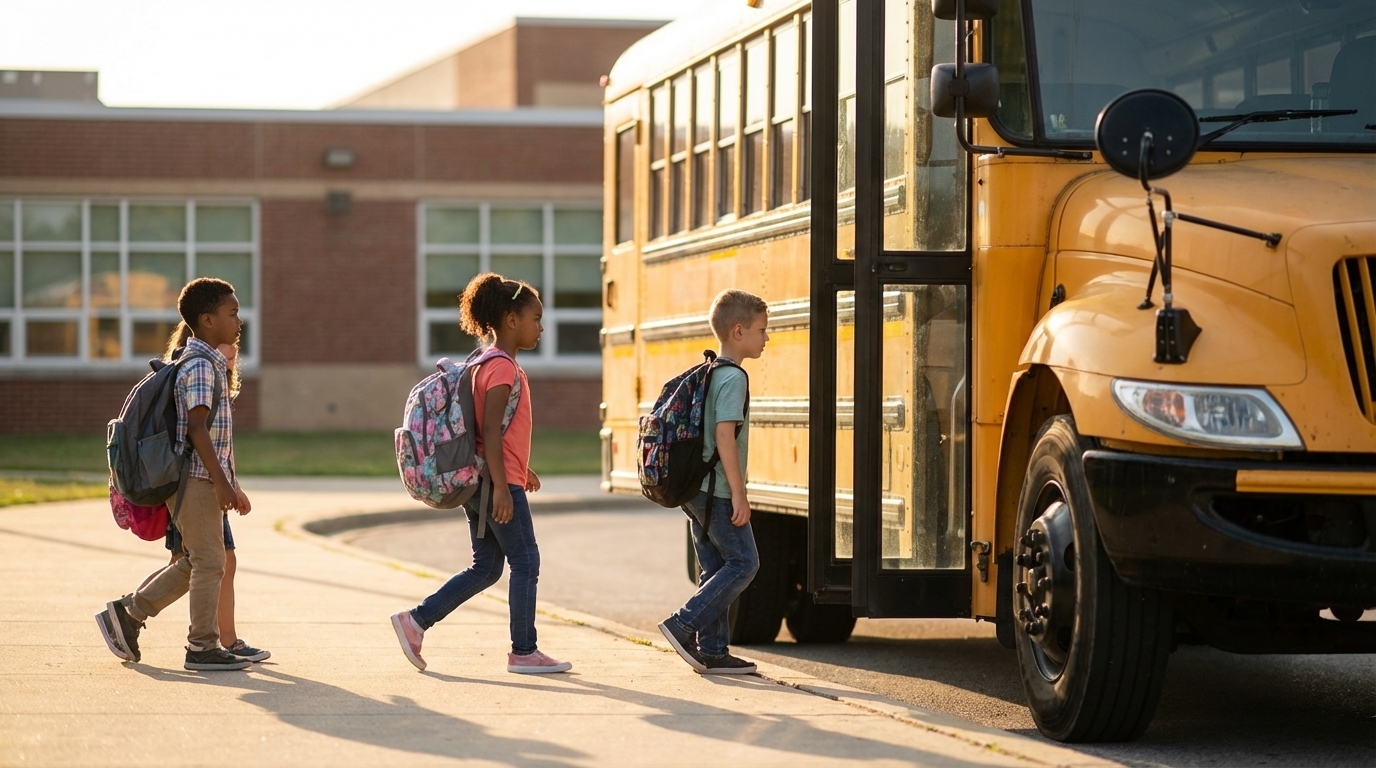
When a school bus does not show up, a student does not get to class. It is that simple, and that consequential. School transportation challenges affect attendance, safety, parent trust, and ultimately student outcomes. For K-12 schools and charter networks that manage their own transportation programs, these challenges are not abstract policy problems. They are daily operational realities that demand real solutions.
The good news: most of the school transportation challenges that disrupt student attendance are solvable. They require better tools, better processes, and better visibility into how your transportation program actually runs. This post breaks down the five most common challenges and what schools and their transportation partners can do about each one.
1. Driver Shortages Affecting School Transportation Reliability
The driver shortage is not new, but it is getting worse. According to the School Pulse Panel, districts across the country are struggling to recruit and retain school bus drivers, forcing route consolidations, delayed start times, and longer rides for students. For schools that operate their own transportation programs or contract with smaller operators, the impact is even more direct. Fewer drivers means fewer routes. Fewer routes means students who cannot get to school.
The shortage is driven by a combination of factors: low pay relative to commercial driving jobs, split-shift schedules that make it hard to attract full-time workers, CDL requirements that narrow the candidate pool, and post-pandemic labor market competition that has pulled drivers into higher-paying logistics and delivery roles.
What Schools Can Do About It
Schools cannot fix the national labor market, but they can make their existing drivers more productive. The single most effective lever is route optimization. When routes are planned efficiently, each driver completes more pickups per run. That means fewer drivers can serve the same number of students.
Manual route planning, where a coordinator draws routes on a map or builds them from memory, almost always leaves efficiency on the table. Software-driven route optimization analyzes pickup locations, time windows, vehicle capacity, and traffic patterns to build tighter routes automatically. The result: more students served per driver, per vehicle, per shift.
Schools should also look at scheduling flexibility. Programs that can mix demand-response trips with fixed routes on the same platform adapt more easily when a driver calls out. Instead of canceling an entire route, the system can redistribute pickups across the remaining vehicles and drivers.
2. Unequal Transportation Access Affecting Student Attendance
Not every student has the same access to transportation, and the gap shows up directly in attendance data. Students in low-income households, students with disabilities, and students who live outside traditional bus route boundaries are disproportionately affected when school transportation programs are rigid or underbuilt.
The National Center for Education Statistics has documented the connection between transportation access and chronic absenteeism. Students who lack reliable transportation miss more school days, fall behind academically, and are more likely to disengage from school altogether. For charter schools and specialized programs that draw students from across a metro area, this challenge is especially acute. Your students do not all live in the same neighborhood, and a single fixed-route bus schedule may not reach them.
What Schools Can Do About It
The fix starts with flexible service design. Schools that can offer a mix of transportation models, including fixed routes for high-density corridors and demand-response service for students in harder-to-reach areas, cover more ground without needing a massive fleet.
A platform that supports multiple service types within a single system makes this practical rather than theoretical. Your transportation coordinator should be able to schedule a fixed morning route and a demand-response afternoon pickup for the same student, managed from one dashboard, without switching between tools.
Parent-facing communication matters too. When families receive real-time notifications about pickup times and vehicle location, they can plan around the schedule instead of guessing. That predictability reduces missed pickups and builds the trust that keeps families using the program.
3. Rising Operational Costs Squeezing School Transportation Budgets
Fuel prices, insurance premiums, vehicle maintenance, and driver wages have all increased significantly over the past several years. For schools that fund their own transportation programs, those increases compete directly with instructional spending. Every dollar that goes to an inefficient route is a dollar that does not go to a classroom.
The cost pressure is compounded by inefficiency. Schools running routes that were designed years ago and never re-optimized are almost certainly spending more per student than they need to. Deadhead miles, where a vehicle drives without students on board, are one of the biggest hidden costs in school transportation. So are underutilized vehicles that run half-full because the route design does not match current enrollment patterns.
What Schools Can Do About It
Cost control in school transportation comes down to three things: route efficiency, vehicle utilization, and visibility into where money is actually going.
Route optimization reduces deadhead miles and ensures each vehicle carries close to its capacity on every run. Trip scheduling that accounts for actual student enrollment, not last year's patterns, keeps routes aligned with current demand. And reporting that tracks cost per student, cost per route, and vehicle utilization over time gives administrators the data they need to make informed decisions about where to invest and where to cut.
Schools that move from static, manually planned routes to software-driven scheduling typically find they can do more with fewer vehicles. That is the most direct path to lower cost per student served.
4. Lack of Real-Time Tracking and Visibility
When a parent calls the school office to ask where the bus is, the office should not have to call the driver to find out. Yet that is exactly how many school transportation programs still operate. There is no live vehicle tracking, no automated arrival notifications, and no way for administrators to see whether routes are running on time until a complaint comes in.
This lack of visibility creates problems on multiple levels. Parents lose confidence in the program. Administrators cannot identify and fix service issues proactively. Drivers have no support system when something goes wrong on a route. And when incidents do happen, there is no data trail to reconstruct what occurred or to prevent it from recurring.
What Schools Can Do About It
Real-time visibility is a solved problem, if you have the right tools. A dispatch dashboard that shows live GPS positions of every vehicle, the status of every stop, and the current progress of every route gives your transportation team the oversight they need to manage by exception rather than by phone call.
For parents, automated notifications, including trip confirmation, estimated arrival time, and pickup completion, replace uncertainty with information. A parent who knows the bus is eight minutes away does not need to call the front office. A parent who has no information will call every time.
For administrators, real-time data also means real-time accountability. On-time performance, route completion rates, and incident logs are captured automatically. You do not have to compile them from driver call-ins or handwritten logs. The data exists because the system generated it while running the program.
5. Complex Logistics with Inadequate Tools
Managing school transportation is a logistics operation. Multiple routes, multiple drivers, multiple vehicle types, varying student needs (including wheelchair accessibility and special accommodations), and changing schedules all need to be coordinated daily. Most school transportation programs were not built to handle this complexity. They were built to handle a single fixed route with a single bus and a single driver.
When the coordination tool is a spreadsheet, a whiteboard, or a dispatcher's memory, things break down as the program grows. A single scheduling error can leave a student stranded. A missed communication about a driver change can cascade into a morning of phone calls. And when schools need to report on transportation performance for board meetings, grant applications, or compliance reviews, the data simply does not exist in a usable form.
What Schools Can Do About It
The core problem is tool fragmentation. Schools use one system (or no system) for scheduling, a different tool for GPS tracking, a phone tree for driver communication, and a spreadsheet for reporting. Each disconnected tool creates a gap where information gets lost and errors multiply.
A single platform that handles scheduling, dispatch, driver management, vehicle tracking, rider communication, and reporting eliminates those gaps. When a schedule change automatically updates the driver app, notifies affected families, and adjusts the dispatch view, there is no room for a missed handoff.
For schools managing students with different transportation needs, configurable service rules matter. The ability to set eligibility criteria, vehicle-type requirements, capacity constraints, and pickup windows from an admin portal, without needing custom development, means the system adapts to your program design instead of forcing your program into a rigid template.
How SHARE Mobility Helps Schools Solve Transportation Challenges
The five school transportation challenges above share a common root cause: programs are trying to deliver a complex, high-stakes service with tools that were not built for the job. SHARE Mobility was built to close that gap.
SHARE is a cloud-based transportation management platform that gives schools and their transportation partners the tools to schedule trips, optimize routes, dispatch drivers, track vehicles in real time, communicate with families, and report on program performance, all from one system. The platform supports both fixed-route and demand-response operations, so schools can design the service model that fits their student population rather than working around a rigid system.
For schools that contract transportation to a third-party operator, SHARE's white-label capability means the rider app, driver app, and all family communications carry the school's brand. Families interact with their school's transportation program, not a software vendor.
The results speak for themselves. As Katie Frank, Senior Operations Associate at KIPP Columbus, put it: "Partnering with SHARE has increased student attendance as well as school and parent satisfaction for daily transportation."
That outcome, increased attendance through reliable transportation, is what every school transportation program exists to deliver. The question is whether your current tools give you the visibility, efficiency, and reliability to make it happen consistently.
Getting Started
If your school or transportation partner is managing routes on spreadsheets, fielding parent calls about late buses, or watching costs climb without clear data on why, there is a better path. The school transportation challenges covered here are solvable with the right platform and the right approach.
Explore how schools and campus transit programs use SHARE to build reliable, data-driven transportation services that keep students in their seats, at school, on time.