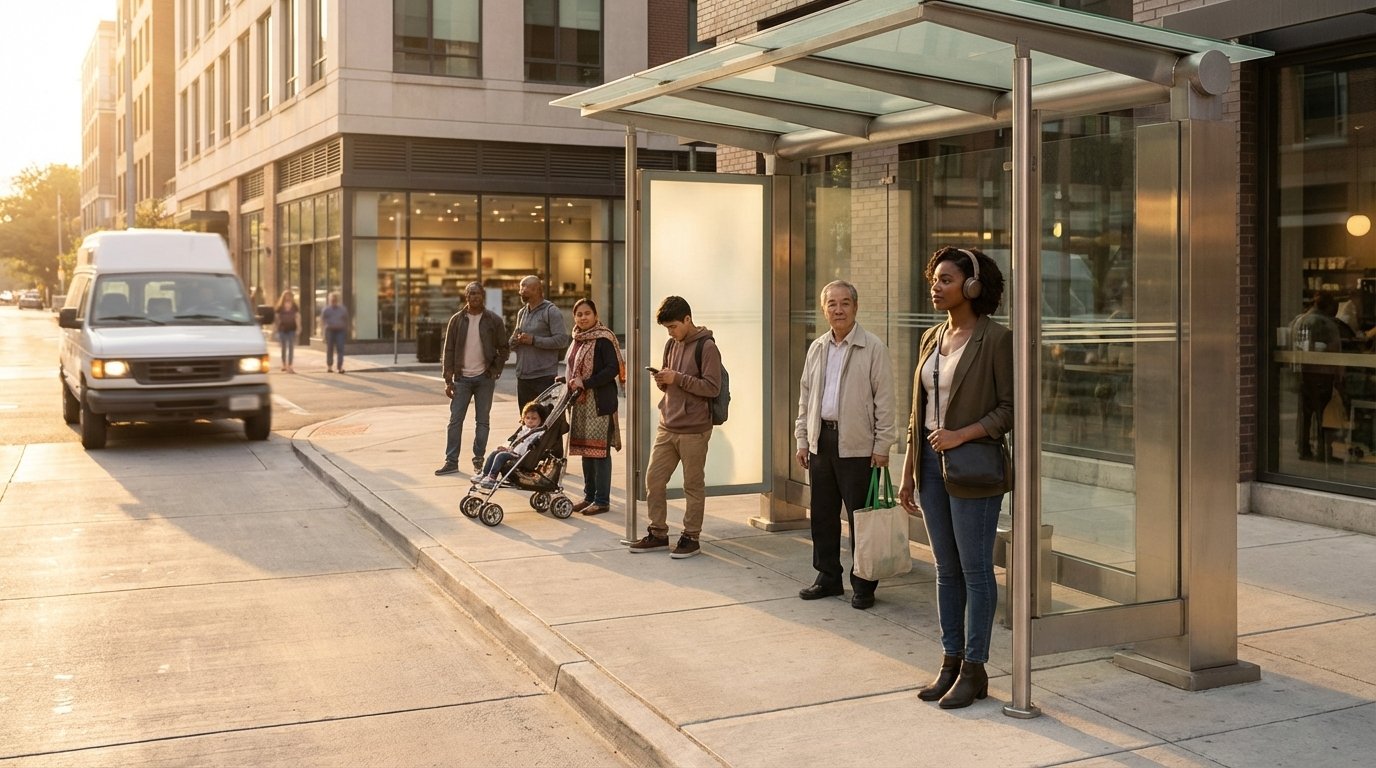
The first and last mile problem is not a new concept. Transit planners have been working around it for decades. The bus or rail line exists. The corridor is served. But a meaningful share of potential riders live or work just far enough from a stop that the trip does not work. They cannot walk a half-mile to a platform, cannot wait at a stop in winter, or cannot make the transfer work with their schedule. So they do not ride.
Microtransit examples from cities across the country show one consistent pattern: on-demand service deployed thoughtfully in the right geography closes gaps that fixed route transit cannot reach. Not by replacing the broader system, but by handling the trips that the system was never built to handle.
This post covers how cities are actually using microtransit to solve first and last mile problems. Not in theory. In operation. The patterns below reflect how these programs are designed, who they serve, and what makes them work operationally.
What the First and Last Mile Problem Actually Looks Like
First mile refers to the trip from a rider's origin to a transit stop or hub. Last mile refers to the trip from a transit stop or hub to the rider's final destination. Both represent connection points where riders fall out of the system.
In dense urban cores, the first and last mile is often walkable. Stops are close together and the pedestrian environment supports short walks. In suburban and exurban areas, that assumption breaks down. Stops are spaced further apart. Sidewalks may not exist on every block. Distances that look manageable on a map are not manageable for a senior with limited mobility, a rider without a car, or someone traveling with young children.
The result is a coverage illusion: a transit map that looks like it serves a broad area, but actually serves the narrow corridor between stops rather than the neighborhoods those stops are supposed to reach. Residents a quarter mile or more from a stop effectively have no transit access even when a route runs through their community.
On-demand microtransit addresses this by operating within a defined zone and coming to riders rather than expecting riders to come to a fixed point. The vehicle picks up at or near the rider's location, drops off at a hub, stop, or destination, and adjusts its path dynamically based on who has requested a ride. The gap between home and stop disappears because the stop, effectively, moves to wherever the rider is.
Microtransit Examples: Patterns Cities Are Using
There is no single way to deploy microtransit for first and last mile connectivity. Cities are using several distinct operational patterns depending on their geography, rider population, and transit infrastructure. The four patterns below cover the most common approaches in active use.
Pattern 1: On-Demand Service for Seniors and Residents with Disabilities
The most established microtransit use case in smaller cities and suburban municipalities is dedicated on-demand service for seniors and residents with disabilities. This population has a genuine first mile problem that fixed route cannot solve: many of these riders cannot walk to a stop, cannot stand and wait outside, and cannot manage a transfer independently. Door-to-door service is not a convenience. It is a requirement.
Traditional paratransit fills some of this need, but it comes with constraints. Advance booking windows can be long. Service areas are often limited to ADA-required coverage rather than the broader community. And operational costs per trip are high because paratransit typically runs individual trips rather than sharing vehicles across multiple riders with similar origins and destinations.
On-demand microtransit can serve a similar population with a more flexible model. Riders request trips through an app or by phone. The routing system groups riders with compatible origins, destinations, and time windows into shared rides. Vehicles are dispatched based on real-time demand rather than a fixed schedule. The operational result is more trips served per vehicle, lower cost per ride, and greater scheduling flexibility for riders who may not know their exact departure time until shortly before travel.
The City of Dublin, Ohio, built exactly this model with the Dublin Connector, an on-demand service for seniors and residents with disabilities. The program has delivered more than 29,900 rides. Approximately 80 percent of ridership comes from seniors and residents with disabilities, directly matching the program's design intent. The overall satisfaction rating is 4.95 out of 5. That level of satisfaction reflects what happens when a service model genuinely fits the population it is built to serve.
The Dublin Connector is run on SHARE's platform. You can read the full program details in the Dublin Connector case study.
What makes programs like Dublin Connector work is not just the on-demand format. It is the software infrastructure behind it. Riders book through a mobile app or by phone. The system handles routing automatically, grouping riders into efficient shared trips without dispatcher intervention on every booking. Drivers receive turn-by-turn navigation through the driver app and get real-time updates as new requests are added or existing trips are modified. The dispatch dashboard gives the program coordinator live visibility into every vehicle and trip without needing to call drivers to check status.
That operational layer is what separates a sustainable program from one that collapses under its own coordination overhead. Demand-response transit for seniors requires precision. A missed pickup for a rider who has a medical appointment is not an inconvenience. It is a service failure with real consequences. The software has to be reliable enough that coordinators trust it, and flexible enough that exceptions can be handled in real time.
Pattern 2: Neighborhood Connectors to Transit Hubs
A second pattern gaining traction is using microtransit to connect lower-density residential areas to existing transit hubs: commuter rail stations, bus rapid transit stops, or major transfer points. The fixed route handles the high-frequency trunk service. The microtransit program handles the neighborhood-level connections that extend the trunk route's effective reach.
This design is sometimes called a hub-and-spoke or feeder model. The spoke is the on-demand vehicle serving a residential zone. The hub is the transit stop where riders transfer to the higher-frequency fixed service. The microtransit leg might cover one to three miles in each direction, enough to capture a large catchment area around a station without the cost and complexity of running bus routes into every adjacent neighborhood.
Operationally, this pattern requires coordination between the microtransit program and the fixed route or rail schedule. Riders using a feeder service to connect to a train cannot afford to miss their transfer. The on-demand vehicle needs to arrive at the hub with enough buffer time for the connection. That means the routing system has to account for transfer timing, not just trip efficiency in isolation.
Modern microtransit platforms handle this through configurable time windows. Operators set arrival parameters that ensure vehicles reach hub stops within a defined window relative to train or bus departure times. The route optimization engine accounts for those constraints when grouping riders and generating routes, so drivers are not routing efficiently from a pure mileage standpoint while inadvertently causing riders to miss connections.
According to APTA research and transit statistics, a significant share of transit non-riders cite access to stops as a primary barrier. Feeder microtransit directly addresses that barrier without requiring capital investment in additional fixed route infrastructure or frequency improvements that may not be warranted by ridership density.
Pattern 3: Coverage in Low-Density Areas Where Fixed Route Cannot Pencil Out
Some parts of a city or county simply do not generate enough ridership to justify a fixed route. Running a bus on a 60-minute headway through a low-density area to serve six boardings per run is expensive service delivery at poor cost efficiency. But eliminating service entirely leaves residents without transit access, which creates inequity and often draws community and political pressure on transit agencies to maintain coverage they cannot fund.
On-demand microtransit offers a viable middle path. A zone-based on-demand service in a low-density area can cover a much larger geography than a fixed route for the same or lower operating cost, because vehicles only move when rides are requested. On a slow day, the vehicles sit. On a busy day, the routing system maximizes efficiency by grouping riders with compatible trips. The cost per ride fluctuates with demand rather than running at a fixed rate regardless of ridership.
This pattern is particularly relevant in suburban areas that grew rapidly over the past few decades and were built around car ownership, not transit. These communities now have residents who are aging out of driving, younger residents who cannot afford vehicles, and workers on shifts that do not align with infrequent fixed route schedules. Microtransit can serve all three populations with a single zone-based program rather than requiring separate service designs for each.
The operational key is zone design. A well-designed microtransit zone is large enough to capture meaningful demand but compact enough that vehicles can complete trips efficiently without excessive deadhead between pickups. Zone boundaries should reflect where riders are actually traveling from and to, not simply where the city limits fall. Programs that use trip request data and ridership patterns to refine zone boundaries over time consistently outperform programs that launch with static zones and never adjust them.
Software configurability matters here. Operators need to be able to adjust zone boundaries, service hours, and vehicle capacity parameters as the program evolves. Programs that require vendor intervention every time a zone boundary shifts cannot adapt quickly enough to stay aligned with actual demand.
Pattern 4: Supplementing Paratransit for Broader Community Coverage
ADA paratransit is a federal requirement, not an optional service. Transit agencies are required to provide complementary paratransit within three-quarters of a mile of fixed route service for riders who cannot use fixed route due to disability. That requirement defines a minimum coverage zone. It does not define a ceiling.
Many communities with significant senior or disability populations find that ADA paratransit alone does not cover all the trips their residents need. Paratransit covers the federally required zone. But residents who live outside that zone, or who need service for trip types that paratransit does not handle well, are left without options.
Microtransit can supplement paratransit by covering gaps in both geography and trip type. A city might run paratransit for ADA-required trips and on-demand microtransit for community trips in areas adjacent to but outside the ADA zone. Or it might use microtransit to serve the same population for trips that do not qualify for paratransit but still represent genuine community transportation needs: grocery runs, social activities, volunteer programs, recreational facilities.
Running both service types on the same platform is operationally practical and reduces administrative overhead. Dispatchers see all vehicles and all trips in one dashboard. Riders use one app. Reporting is unified. A municipality managing both a paratransit program and a community microtransit service does not need two separate systems, two separate training tracks, or two separate data exports when it is time to compile grant reporting.
Platforms built to support multiple service types within a single instance, like SHARE's platform, make this possible without requiring separate software subscriptions or complex integrations between systems.
What Makes These Programs Work Operationally
Looking across microtransit examples from cities that have sustained their programs over time, several operational factors separate programs that grow from programs that stall.
Software-driven routing, not manual coordination. Programs that rely on dispatchers to manually build every route do not scale. The routing workload grows with trip volume. Staff bandwidth does not. Programs that use automated route optimization from the first day build the operational foundation for growth rather than the conditions for coordinator burnout. The system handles the routing logic. Dispatchers handle exceptions.
Rider communication that does not depend on phone calls. In senior-focused programs, the temptation is to keep phone-based booking because it is familiar to the rider population. Phone booking is fine. But relying on phone calls for trip reminders, driver arrival notifications, and schedule changes creates staff workload that compounds as ridership grows. Automated SMS or app notifications keep riders informed without requiring a coordinator to make individual calls for every trip update.
Data that flows automatically into grant reporting. Municipal microtransit programs are often funded in part through federal Section 5310 grants or similar programs. Those grants require outcome reporting: trips delivered, rider demographics, on-time performance, accessibility statistics. Programs that run on modern software platforms generate those reports automatically. Programs built on spreadsheets generate them through hours of manual data compilation before every reporting cycle. That difference compounds over time and affects whether a program can demonstrate its value to funders or city council.
Flexibility to adjust without rebuilding. Demand patterns shift. Rider populations evolve. Zones that made sense at launch may need adjustment after six months of operation. Programs that can make those adjustments from a software configuration panel, without vendor support tickets or engineering involvement, stay aligned with actual rider needs. Programs that cannot adjust become misaligned over time and eventually show it in ridership numbers.
The Dublin Connector: What Sustained Performance Looks Like
The Dublin Connector is the clearest example in SHARE's customer base of what a well-designed, well-operated on-demand municipal microtransit program looks like over time.
The program serves seniors and residents with disabilities in Dublin, Ohio, a suburban city in the Columbus metro area. It operates as a demand-response service: riders book trips through the app or by phone, and vehicles are dispatched based on real-time demand rather than a fixed schedule. There are no fixed stops. The vehicle comes to the rider.
The outcomes are documented. More than 29,900 rides completed, demonstrating ongoing demand for flexible, on-demand travel. Approximately 80 percent of ridership from seniors and residents with disabilities, aligning with program goals. An overall satisfaction rating of 4.95 out of 5 among riders, reflecting reliability and ease of use.
Those numbers are not the result of a pilot that has not yet met reality. They reflect an operational program that has run through normal operating conditions, handled exceptions, and continued to deliver service that its riders depend on. The 4.95 satisfaction rating is particularly telling. Programs that riders depend on but do not actually trust do not produce scores like that. Trust comes from consistency, and consistency comes from having software infrastructure that does not require heroic dispatcher effort to keep the service running.
What the Dublin Connector illustrates for other municipal transit planners is that the first and last mile problem for seniors and residents with disabilities is solvable. The technology exists to run reliable, rider-friendly, software-driven on-demand service at a scale that small and mid-size municipalities can actually sustain. The barrier is not technical. It is choosing the right service model and the right software to support it.
Starting Your Own Program: What to Think Through First
For transit planners and city managers evaluating microtransit for the first time, the examples above suggest a few practical starting points.
Define your gap precisely. First and last mile is a broad category. The operational design for a senior-focused on-demand program looks different from a feeder service connecting a neighborhood to a commuter rail station. Clarity about which gap you are solving shapes every subsequent decision: zone design, vehicle type, booking method, software requirements, and success metrics.
Start with your rider population, not your geography. Geography matters, but who you are serving determines what the service needs to do. A program designed for seniors needs door-to-door capability and accessible vehicles. A program designed for transit-dependent commuters needs reliable connections to fixed route headways. Design around the rider first and let geography follow.
Choose software that grows with the program. A program that launches with three vehicles may need eight vehicles in two years if demand develops. The software platform needs to handle that growth without requiring a system migration or renegotiation of the technology contract. Ask how the platform handles increased trip volume, zone expansion, and new service types before signing a contract.
Build your reporting requirements into the program design from day one. If you are using federal grant funding, know what reporting the grant requires before you launch. Make sure the software platform generates those data points automatically. Discovering a reporting gap after launch is a much more expensive problem than specifying reporting requirements before selecting a platform.
The first and last mile problem is real, and the cities solving it with microtransit are showing that on-demand, software-driven service is the model that works. If you are evaluating a program for your community, SHARE's microtransit solutions page covers the operational model, and the dispatch dashboard overview shows how the software side runs in practice.