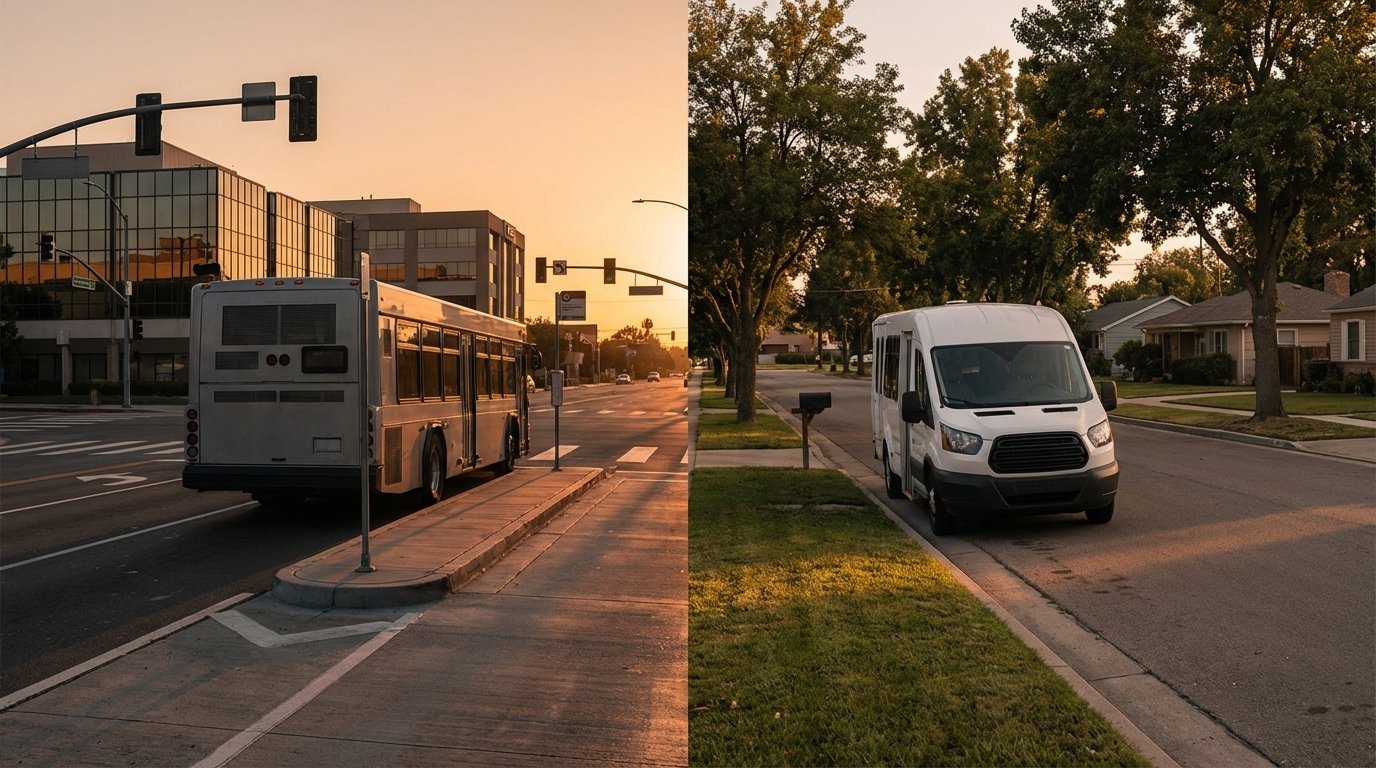
Choosing between microtransit vs fixed route service is one of the more consequential decisions a transit agency or municipal program manager will make. Get it right and the program serves riders well. Get it wrong and you end up running a service model that does not match how people in your community actually need to travel.
Neither model is inherently better than the other. Fixed route has worked for decades in the right contexts. On-demand microtransit is genuinely transformative in the right contexts too. The key word in both cases is "right context." The decision framework below is designed to help operators figure out which context they are actually in, and what questions to ask before committing to one model over the other.
What Microtransit vs Fixed Route Actually Means
Fixed route transit runs on a published schedule. The same vehicle travels the same route at the same times every day. Riders learn the schedule, show up at a stop, and board. The route does not change based on who requests a ride on any given morning. It runs whether it carries two passengers or twenty.
On-demand microtransit works differently. Riders request trips through an app or by phone, and the system routes vehicles to pick them up within a defined service zone. Routes are generated dynamically based on who needs a ride, where they are, and where they need to go. The vehicle comes to the rider, not the other way around. There is no fixed schedule and no fixed path.
Both models share the same underlying purpose: moving people from where they are to where they need to be. What they optimize for is different. Fixed route optimizes for predictability and throughput on high-demand corridors. Microtransit optimizes for coverage and flexibility in areas where demand is dispersed or unpredictable.
According to the American Public Transportation Association (APTA), demand-response and microtransit services have grown significantly as agencies seek to extend coverage into areas where traditional fixed routes are not cost-effective. That growth reflects a practical reality that many transit planners have already encountered firsthand.
When Fixed Route Is the Right Call
Fixed route transit performs best when several conditions are true simultaneously. Understanding those conditions makes it much easier to evaluate whether this model fits a given service area.
High, predictable demand along a defined corridor. Fixed route needs consistent ridership to justify the operating cost. If a corridor reliably generates strong boarding activity at peak hours, fixed route delivers cost-effective service. Buses run full or close to full. Cost per rider stays manageable. The predictability of the route means riders can build their schedules around it.
Dense residential or employment patterns. The classic fixed route environment is an urban or suburban corridor with apartment buildings, employment centers, or retail clusters at regular intervals. Riders live close enough to stops to walk to them. Destinations are concentrated enough that a shared path serves many people efficiently.
Riders who can self-transport to a stop. Fixed route assumes riders can get to a stop and wait. For the general commuting public, this is a reasonable assumption. For seniors, riders with mobility limitations, or residents in areas with limited pedestrian infrastructure, it is often not. That constraint matters significantly when evaluating who your program is designed to serve.
Budget structures that support consistent operating cost. Fixed route transit has relatively predictable costs because the vehicle runs the same route regardless of ridership fluctuations. That predictability is an advantage in budget planning. It is also a constraint: the cost structure does not flex downward when ridership drops.
Transit agencies running high-frequency urban bus lines, cross-town connector routes with strong anchor destinations, or park-and-ride feeders to rail stations are generally operating in fixed route's natural territory. The model was built for those use cases and it handles them well.
When Microtransit Is the Right Call
The case for microtransit becomes clear when the conditions that make fixed route work are absent. Recognizing those conditions early saves agencies from expensive service design mistakes.
Dispersed demand across a wide service zone. In suburban or rural areas, riders are spread out. A fixed route might serve a handful of people per run while traveling several miles. The cost-per-rider on that route is high and getting higher. On-demand service addresses the same geography by routing vehicles only where rides are requested. Vehicles carry more riders per mile traveled and skip the deadhead runs that inflate costs on underperforming fixed routes.
Riders who cannot get to a stop independently. This is the most important differentiating factor for many municipal programs. Seniors and residents with disabilities often cannot walk to a fixed stop, cannot manage a transfer, and cannot reliably predict exactly when they can be ready for a pickup. On-demand microtransit brings the vehicle to the rider's door. That capability is not a feature upgrade. For these riders, it is the difference between a service they can use and one they cannot.
Variable demand patterns across the day or week. Some service areas have strong demand on certain days or at certain times but very light demand otherwise. A fixed route serving a senior center that generates most of its ridership on Tuesday and Thursday mornings is an expensive way to serve Tuesday and Thursday morning riders. Microtransit scales to actual demand: more trips on busy days, fewer on slow ones, with the same vehicles serving the same zone.
First and last mile gaps. In many transit systems, the biggest barrier to ridership is not the bus or train itself but the trip to or from the stop. Microtransit is well-suited to closing that gap, carrying riders from neighborhoods or residential areas to transit hubs where they can connect to fixed route or rail service. The two models work together when the service design accounts for both ends of the trip.
Limited infrastructure. Fixed route transit requires stop infrastructure: shelters, signage, accessible curb cuts, and defined alighting points. Microtransit does not. In communities where that infrastructure does not exist or is difficult to fund, on-demand service can operate on existing road networks without capital investment in stop improvements.
Cost Structure Differences That Actually Matter
The cost comparison between microtransit vs fixed route is more nuanced than it first appears. Neither model is categorically cheaper. What differs is how costs behave relative to ridership and service area size.
Fixed route transit has relatively flat operating costs within a service period. The bus runs the route whether it carries two riders or twenty. Cost per rider is therefore highly sensitive to ridership volume. On high-demand corridors, fixed route can achieve very low cost per rider. On low-demand corridors, the same per-run cost gets divided across far fewer riders and the economics deteriorate quickly.
On-demand microtransit has more variable operating costs. Vehicle hours are tied to trip activity. A dispatcher who is managing five vehicles serving 30 rides per day is running a materially different cost structure than one managing five vehicles serving 80 rides per day. The technology layer, including the software platform that handles booking, routing, and dispatch, is a fixed cost that does not scale with trip volume. That means the software cost per ride drops as ridership grows.
For programs evaluating the two models, the most useful question is not "which model is cheaper?" It is: "what ridership volume does our service area realistically support, and which cost structure performs better at that volume?" A corridor generating 200 boardings per day belongs on a bus. A zone generating 30 on-demand trips per day belongs on a microtransit platform. The math is usually more conclusive than operators expect once they run it against actual demand data.
Infrastructure and Technology Requirements
Fixed route transit requires physical infrastructure: bus stops, shelters, signage, and in many cases accessible amenities at major stops. These are capital costs that may require grant funding, permitting, and construction timelines. For municipalities launching a new service, that infrastructure layer adds lead time and budget complexity before the first ride is ever completed.
Microtransit's infrastructure requirement is primarily software. Operators need a platform that can handle on-demand booking, dynamic routing, driver dispatch, and rider communication. The vehicles themselves can be existing fleet or new acquisitions, but there is no need for stop infrastructure investment. A program can launch in a new zone without laying any physical groundwork beyond identifying pickup and dropoff areas.
That difference has practical implications for how quickly a program can be deployed and adjusted. Fixed route service, once launched with stop infrastructure in place, is relatively rigid. Changing the route means changing signage, notifying riders, and potentially removing or adding physical stops. On-demand service can be adjusted from a software configuration. Zone boundaries, vehicle capacity limits, service hours, and eligible rider categories can all be changed through the admin portal without external coordination.
For programs that anticipate evolving rider needs, a growing service area, or uncertain demand patterns, that configurability is a meaningful operational advantage. Software platforms like SHARE's microtransit solution are designed specifically to give operations teams control over these variables without requiring custom development or vendor support for each adjustment.
The Ridership Profile Question
Who your riders are shapes which model fits. This is not a peripheral consideration. It is central.
A general-purpose commuter service connecting residential neighborhoods to employment hubs draws riders who are mobile, schedule-aware, and capable of planning a multi-leg commute. That profile is well-suited to fixed route. Riders can walk to stops. They adapt to a published schedule. Delays are inconveniences, not emergencies.
A senior transportation program, a paratransit supplement, or an ADA-accessible community transit service serves a fundamentally different rider population. These riders may have limited mobility. They may need door-to-door service. They often cannot stand and wait at an outdoor stop. Their trip schedules may not follow a predictable pattern. Fixed route is a poor fit for this population not because it is a bad transit model but because it was designed around a different rider profile.
The Dublin Connector, a program operated by the City of Dublin, Ohio, illustrates what the right model fit looks like in practice. Dublin launched an on-demand microtransit service for seniors and residents with disabilities. The program has completed more than 29,900 rides, with approximately 80 percent of ridership coming from seniors and residents with disabilities. The overall satisfaction rating is 4.95 out of 5. Those outcomes reflect a service model that was matched to the actual population it was designed to serve.
A fixed route covering the same geography might have generated lower ridership and lower satisfaction because it would have required riders to access stops independently and adhere to a fixed schedule. The on-demand model removed both of those barriers. That is what model-fit looks like.
Hybrid Approaches Worth Considering
Microtransit vs fixed route is not always a binary choice. Some of the most effective community transit programs combine both models, using each where it performs best.
A common hybrid pattern: fixed route service on high-demand arterial corridors with on-demand microtransit feeding riders to and from those corridors in lower-density areas. The bus runs the trunk route on schedule. On-demand vehicles handle the first and last mile, connecting riders who live in dispersed residential areas to fixed stops where they can continue their journey. This design extends the effective coverage of a fixed route system without extending the route itself into areas where ridership does not justify fixed service.
Another hybrid pattern: fixed route during peak periods with on-demand service filling off-peak hours. A corridor that generates strong morning and evening commute ridership may not support midday fixed route frequency. On-demand service can cover midday trips without running a half-empty bus on a schedule that exists primarily to maintain route coverage rather than serve actual riders.
Running both models simultaneously in the same platform is operationally practical. A platform that supports multiple service types within one instance means dispatchers use a single dashboard, data flows into unified reporting, and riders use one app regardless of which service type their trip uses. That integration matters for programs with limited administrative capacity. The last thing a small transit team needs is two separate software systems that generate separate reports and require separate training.
The Decision Framework
Before choosing between microtransit vs fixed route, work through these five questions. The answers usually point clearly in one direction.
What does demand look like in your service area? If you have consistent, concentrated demand along a defined corridor, fixed route is a strong candidate. If demand is dispersed, variable, or hard to predict, on-demand microtransit is likely a better fit. Pull any available trip data or conduct a needs assessment before committing to a service design.
Who are you primarily serving? General commuters and the transit-independent public can use fixed route effectively. Seniors, residents with disabilities, and riders who cannot self-transport to a stop need a different model. ADA paratransit requirements add another layer of consideration here, since demand-response service can satisfy those requirements in ways that fixed route cannot.
What is your infrastructure starting point? If fixed stop infrastructure is not in place, on-demand service has a lower launch barrier. If infrastructure already exists and ridership supports it, fixed route may be the faster path to service launch. If you are building from scratch, account for the full capital cost of stops before comparing operating cost models.
How might your service area or ridership change in the next three to five years? A service model that works for today's demand profile may not work for a larger or differently distributed population. On-demand microtransit has a lower adjustment cost when demand patterns shift. Fixed route requires more structural change to respond to ridership evolution.
What does your budget look like relative to expected ridership? Run the cost-per-rider math for both models at your realistic ridership projections. The model that produces a sustainable cost structure at your expected volume is the right starting point. On-demand service increasingly makes economic sense as software costs have come down and route optimization has improved. The route optimization technology driving modern microtransit platforms has reduced the per-trip cost of on-demand service considerably compared to first-generation demand-response models.
There is no universal answer to the microtransit vs fixed route question. The right answer is specific to a service area, a rider population, an infrastructure baseline, and a budget. What this framework gives you is a structured way to reach that answer with less guesswork.
If you are evaluating an on-demand or microtransit program and want to understand how other municipal operators have structured their service design decisions, SHARE's microtransit solutions page walks through the operational model in detail. And if you are considering a model that handles both fixed route and on-demand service, the fixed route vs. demand response resource covers the operational tradeoffs in depth.