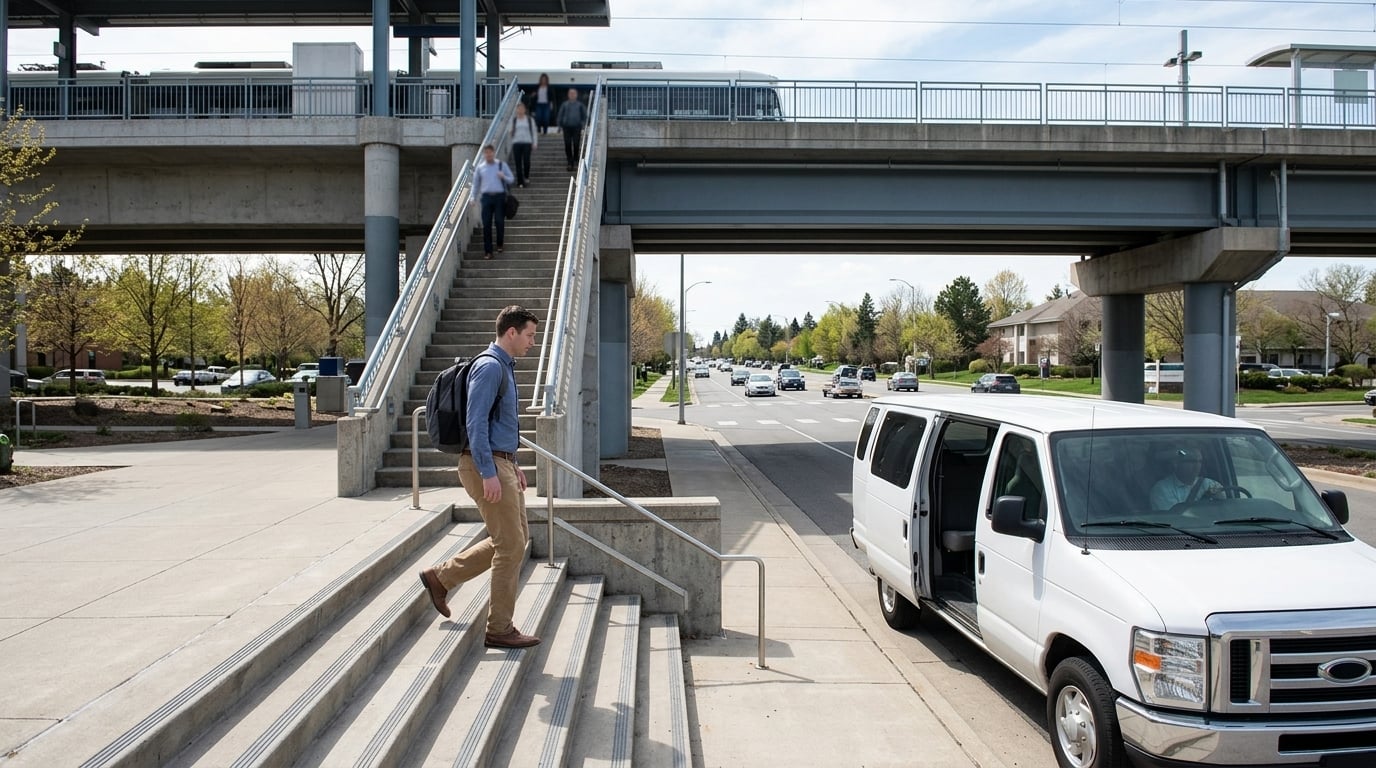
A worker misses their shift because the bus drops them off a mile from the plant entrance. A senior shows up for a medical appointment and finds the transit stop is three blocks from the clinic with no sidewalk. A new hire accepts a job offer, then quits two weeks later because getting there every day isn't sustainable.
These aren't edge cases. They're the last mile problem, playing out across communities every day. For the transit agencies, municipalities, and operators trying to solve it, the last mile is often the hardest part of running a transportation program.
What Is Last Mile Transportation?
Last mile transportation describes the final segment of a journey: the gap between a transit hub and a rider's actual destination. Bus stops, train stations, and park-and-ride facilities usually have solid coverage. The problem is what happens at the edges — the blocks and miles between those hubs and where people actually need to go.
The term comes from logistics. In supply chain, "last mile delivery" describes the most expensive leg of the journey. In transit, it captures the same idea: the segment that's hardest to serve efficiently, and the one that determines whether a rider can complete their trip at all.
The "last mile" isn't always literally one mile. It might be three blocks or three miles. What matters is the gap between a mass transit stop and the specific place someone needs to be:
- A factory entrance a mile past the bus route
- A dialysis clinic with no sidewalk from the nearest stop
- A school or job site outside the transit corridor
According to APTA's public transit research, access gaps at the start and end of trips are among the most consistent barriers to ridership.
Solving last mile problems requires a different approach than the main transit network. Fixed routes work well for high-density corridors. Last-mile connections need flexibility: on-demand service, feeder routes, or employer-sponsored shuttles that go where fixed routes can't reach.
Why Last Mile Transportation Is Harder Outside Urban Centers
Urban core transit systems have density working in their favor. Stops are close together. Destinations cluster near transit hubs. The walk from a stop to a destination is usually short enough that most riders can manage it.
Suburban and rural areas don't have those advantages:
- Stops are farther apart
- Destinations are spread out across wider geography
- Workers, seniors, and residents who most need reliable transit often live farthest from the stops
For employers, the last mile problem becomes a direct hiring constraint. When a plant or distribution center sits outside a transit corridor, the available labor pool shrinks to workers who own cars. U.S. Census Bureau commuting data shows that car ownership is the dominant mode for suburban workers — not because workers prefer it, but because transit rarely reaches the destination.
Employers who run a shuttle from a transit hub to their facility expand their hiring radius. Workers who couldn't reasonably reach the job can now get there reliably.
For municipalities running paratransit and senior transit programs, the challenge is the same. Riders who depend most on the service are the ones least able to bridge a gap on their own. A program that works 90% of the way but fails at the final leg isn't serving its riders.
The Real Cost of a Poor Last Mile Connection
When last mile transportation fails, the consequences are measurable. Here's what it looks like across different organizations:
- For employers: Workers cite unreliable transportation when they leave within their first 60 days. The commute looked workable in the interview. It becomes unsustainable when they're showing up every day. Absenteeism tied to transit access is common at manufacturing and logistics facilities.
- For transit agencies: Ridership stalls when riders can't complete trips. Every rider who gives up and drives means more traffic, more emissions, and less system revenue.
- For municipalities: Residents without last-mile access are effectively cut off from employment, medical appointments, and services. For seniors and people with disabilities, it's a direct loss of independence and access to care.
- For program operators: Manual workarounds for last-mile coordination — phone calls, spreadsheet routing, informal carpool arrangements — create overhead that scales poorly and fails without warning.
How Transit Operators Are Solving Last Mile Transportation Gaps
The most effective last-mile solutions share a common pattern: flexible, demand-responsive service that fills gaps where fixed routes can't run economically.
Microtransit and on-demand service are the most widely deployed approach. Riders book trips within a defined zone, and the system assigns vehicles dynamically based on actual demand. This is more cost-effective than extending fixed routes into lower-density areas, and it delivers riders to their specific destination rather than a nearby stop. SHARE's microtransit solutions page covers how operators are structuring these programs.
Employer-sponsored shuttle programs close the gap between transit hubs and job sites. These are standard practice in manufacturing, food production, and logistics. A shuttle from the nearest transit hub to the plant entrance means workers who rely on public transit can complete the full commute.
Feeder routes connect major transit stops to destination clusters: medical districts, employment campuses, retail corridors. Unlike fixed routes designed around assumed demand, feeder routes are built around origin-destination data that reflects where riders actually need to go.
Each approach requires the same underlying capability: a system that can schedule, dispatch, and track flexible service without creating more manual work than the problem it's solving.
What Last Mile Transportation Software Gets Right
Demand-responsive last-mile programs are harder to run than fixed routes. Scheduling isn't static. Riders change. No-shows happen. Vehicles need to be dispatched efficiently across a zone, not along a set path.
Manual systems break down at scale:
- Phone-based scheduling creates errors
- Radio dispatch gives dispatchers no real-time visibility
- Paper route sheets can't adapt when a rider cancels or a vehicle runs late
- Managers have no clean data to show performance when grant renewals depend on outcomes
Purpose-built transit software changes what's possible. Scheduling is automated. Routes adapt to actual demand. Dispatchers see every vehicle and every trip on one screen. Riders get booking confirmations and arrival notifications. The dispatch dashboard gives operations teams real-time visibility without constant phone contact with drivers.
The reporting layer captures what the program is actually delivering: ridership totals, on-time performance, trip completion rates. That data turns a last-mile program from an operational cost into a documented outcome.
How Operators Are Running Last Mile Transportation on SHARE
SHARE was built for demand-responsive service — the kind of flexible, zone-based operation that last-mile transportation requires. Scheduling, dispatch, rider communication, and reporting run from one system.
The City of Dublin, Ohio put this to work with the Dublin Connector, an on-demand transit program for seniors and residents with disabilities. Before SHARE, the program ran on phone-based scheduling and static routes that couldn't adapt to real rider needs. Since launch, the Dublin Connector has completed more than 29,900 rides with a 4.95 out of 5 satisfaction rating.
The City of Hilliard, Ohio runs a similar program for older adults and residents with disabilities. Trips per driver on Hilliard Express increased 48 percent year over year — without adding vehicles or staff.
Both programs are demand-responsive. They're doing exactly what fixed-route service can't: meeting riders where they are and getting them where they need to go.
If you're evaluating how to close last-mile gaps in your service area, SHARE's microtransit solutions page covers how operators are structuring on-demand and demand-response programs. The Dublin Connector case study shows the outcomes in detail for a program that started from scratch.