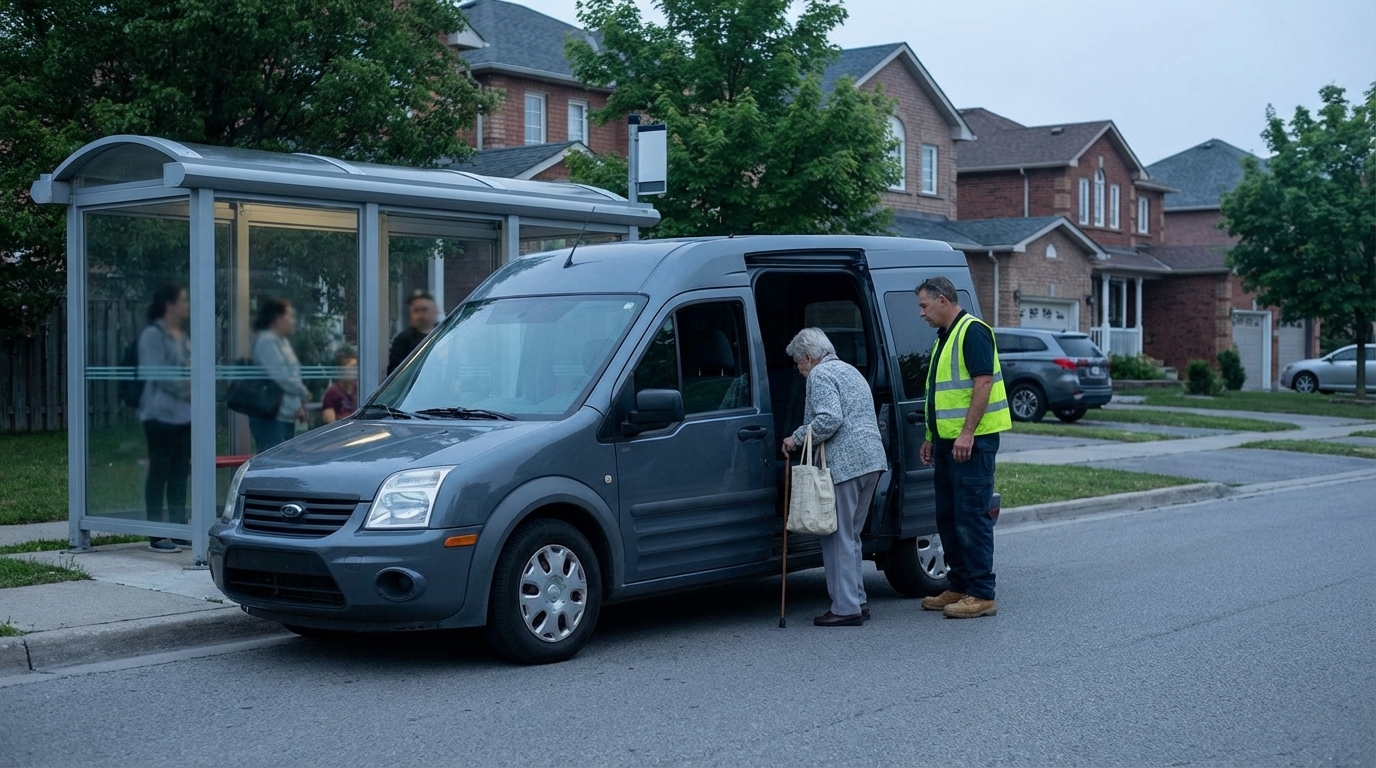
Most communities run their transportation programs in one of two modes: a bus that follows the same route at the same times every day, or nothing at all. For dense urban corridors, the bus works. But for the suburban neighborhoods, smaller cities, and rural counties where millions of people actually live and work, fixed routes either don't exist or don't serve the destinations that matter.
That gap is where microtransit operates. For municipalities, transit agencies, and fleet operators tasked with closing it, understanding what microtransit is and how it works is the first step toward running it well.
According to the American Public Transportation Association, 45 percent of Americans have no access to public transportation at all. Many more live in areas where service technically exists but doesn't serve their actual needs: the route doesn't run on third shift, the stop is two miles from the facility, the bus doesn't reach the medical clinic. Fixed-route transit was built for predictability and scale. It works when demand is high and consistent enough to justify running a vehicle on a set schedule regardless of ridership. In low-density environments, that model breaks down. Vehicles run mostly empty. Cost per rider climbs. And the people who most need transportation stay underserved.
Microtransit was built for exactly this situation.
What Is Microtransit?
Microtransit is a demand-responsive transit service that uses smaller vehicles and flexible routes to serve riders based on actual demand. Instead of a bus running a fixed path at set times, a microtransit vehicle routes dynamically: going where riders request, when riders request it, within a defined service zone.
The defining characteristics are consistent across the category: smaller vehicle footprint (typically vans or minibuses rather than full-size buses), technology-enabled booking and dispatch, and route flexibility driven by rider demand rather than a predetermined schedule.
Most microtransit programs operate under one of two models, or a combination of both:
- On-demand: Riders request trips in real time through a mobile app or phone booking. Software optimizes routes dynamically as new requests come in, routing vehicles to serve multiple riders efficiently within the zone. There is no scheduled departure time. The vehicle is dispatched when the rider requests it.
- Advance-scheduled: Riders book trips ahead of time, sometimes a day or more in advance. This model is common in senior transit and paratransit programs where riders need predictable pickup windows. Routes are optimized in advance and riders receive confirmed pickup times.
Many programs run both models simultaneously, or combine elements of each depending on the rider population and service area.
Who Microtransit Serves
The populations that depend on microtransit most are the same ones traditional fixed-route service routinely fails: seniors and residents with disabilities who cannot drive and live in areas where a bus stop isn't within walking distance; low-income workers whose jobs are in employment corridors that transit doesn't reach; and residents of smaller cities and counties that have never had formal public transit infrastructure.
Microtransit is also used as a first/last mile connector, bridging the gap between a rider's home or workplace and a transit hub, train station, or major bus route. In these programs, microtransit doesn't replace the fixed-route network. It extends the network's reach to people who couldn't access it otherwise.
The organizations that operate microtransit programs span several types: municipal transit agencies and county governments running community services, third-party fleet operators contracted by cities, and private employers running demand-response shuttle programs for their workforce. Each has different accountability requirements and rider populations, but the operational model is fundamentally the same.
Federal programs like the FTA's Section 5310, which funds transportation services for seniors and individuals with disabilities, have made microtransit an accessible option for municipalities that couldn't otherwise bear the infrastructure cost.
Microtransit vs. Fixed-Route Transit
Understanding what microtransit is becomes clearer when you set it directly against what most people think of as public transit.
Fixed-route transit runs a predetermined path on a set schedule. The 8:15 bus leaves at 8:15 and follows the same route regardless of how many riders board. It serves high-demand corridors efficiently because the volume justifies the schedule. But in low-density environments, this model runs mostly empty vehicles at high per-rider cost.
Microtransit routes dynamically. There is no predetermined path. The vehicle goes where riders request, optimized by software to serve as many trips as efficiently as possible within the service window. In low-demand, low-density environments, this is more efficient than maintaining fixed routes that don't justify the frequency.
The two models are complementary, not competitive. Fixed-route transit dominates high-density urban corridors. Microtransit fills the gaps. Many transit systems run both, using demand-response service to extend coverage into the neighborhoods and service areas where fixed routes can't justify the cost. For a closer look at how the operational tradeoffs break down, the fixed-route vs. demand-response guide covers both models in detail.
The Role of Technology in Modern Microtransit
What separates modern microtransit from earlier demand-responsive models, like the dial-a-ride programs of the 1980s and 90s, is software. Earlier demand-responsive transit required heavy manual dispatch effort. A coordinator took calls, manually slotted trips into a schedule, and relayed instructions to drivers over the radio. It worked at low volumes. It didn't scale.
Modern microtransit software handles the operational complexity automatically. When a rider books a trip through an app or phone, the platform ingests the request, runs it through a routing optimization engine, and generates an updated route for the driver, in real time, without a dispatcher placing every call. Multiple riders are grouped into efficient shared trips. Routes update dynamically as new requests come in throughout the service day.
On the dispatch side, operators get live visibility into every vehicle, every active route, and every rider in transit through a single dispatch dashboard. When something needs intervention, dispatchers can act immediately because they can see exactly what's happening. Drivers receive their routes and navigate through a mobile app with turn-by-turn guidance. Riders receive automatic notifications: trip confirmation, vehicle ETA, and pickup reminders.
No phone tree. No manual calls. The platform handles the communication layer so staff can focus on service quality.
What to Look for in Microtransit Software
For transit agencies and operators evaluating platforms, the choice of software has a direct effect on service efficiency, staff capacity, and rider satisfaction. These are the criteria that separate platforms enabling efficient operations from ones that simply digitize manual work.
Route optimization quality. The routing engine is the operational core of any demand-responsive platform. A strong engine evaluates hundreds to thousands of potential route combinations simultaneously to find the most efficient arrangement, maximizing riders served, minimizing miles driven, and reducing the number of vehicles needed. It should handle mid-route additions without disrupting existing assignments.
Real-time dispatch visibility. Every dispatcher managing a microtransit program needs a live view of vehicle locations, trip status, and rider progress in a single screen. When a situation requires intervention, response time depends on how quickly the team can see what's happening.
Rider experience. Booking needs to be accessible via a mobile app for riders who are comfortable with technology and via phone for those who aren't. Trip notifications and confirmations are not optional. For programs serving seniors and riders with disabilities, the interface needs to be simple, accessible, and forgiving.
Reporting for accountability. Publicly funded programs report to city councils, grant agencies, and community stakeholders. The software needs to generate clean, exportable data on ridership, trip completion rates, on-time performance, and rider demographics automatically, without manual data pulls.
Configurability without custom development. No two microtransit programs are identical. Service zones, eligibility rules, fare structures, and time windows vary by program and by rider type. The platform should let operators configure these parameters from an admin portal, not an engineering ticket queue.
What Microtransit Looks Like in Practice
These requirements aren't theoretical. They're the operational reality that municipalities building real programs face, and they're what led cities like Dublin and Hilliard, Ohio to run their programs on SHARE.
The Dublin Connector, an on-demand microtransit service for seniors and residents with disabilities, has completed more than 29,900 rides with a 4.95 out of 5 satisfaction rating. Approximately 80 percent of ridership comes from the program's target population: seniors and residents with disabilities. The program is software-driven. SHARE handles the routing, dispatch, rider communication, and reporting. City staff focus on the riders.
The Hilliard Express, an advance-scheduled door-to-door program for older adults and residents with disabilities, has delivered more than 11,000 rides since launch. Trips per driver increased 48 percent year over year as the routing matured, letting the same drivers and vehicles serve more riders without adding resources.
Both programs are operated by municipalities. Both demonstrate what a software-driven microtransit operation looks like at its best: consistent service, measurable outcomes, and the ability to scale without proportional increases in staff.
If you're evaluating software for a municipal microtransit or demand-response program, the SHARE microtransit page covers how the platform supports these programs. The case studies page has the full Dublin and Hilliard outcome data.