A large food manufacturer in rural Kentucky couldn't fill over 200 positions because workers lived too far away. SHARE connected two labor markets to the facility and filled 92 roles in four months.
The manufacturer faced a structural talent shortage rooted in geography. The facility's rural location and shift schedule meant the only viable candidates were people within driving distance. That pool was too small to fill open headcount, and it had no room to grow under the existing hiring approach.
Workers who could fill the roles existed in nearby markets, some more than 60 miles away in opposite directions. Without a reliable daily connection between those workers and the facility, those markets were effectively inaccessible. Over 200 positions remained open, with costs compounding at roughly $12,000 per role per month.
Recruiting within driving distance alone could not fill open roles at the pace or volume the company required.
SHARE's Commuter Analysis identified priority hiring zones by mapping population density and socio-economic data. The platform then designed multi-directional commute routes connecting two labor markets to the facility and scaled ridership as more workers enrolled.
SHARE mapped population density and socio-economic data to identify hiring zones, pointing the company toward talent markets that had been completely out of reach without transportation.
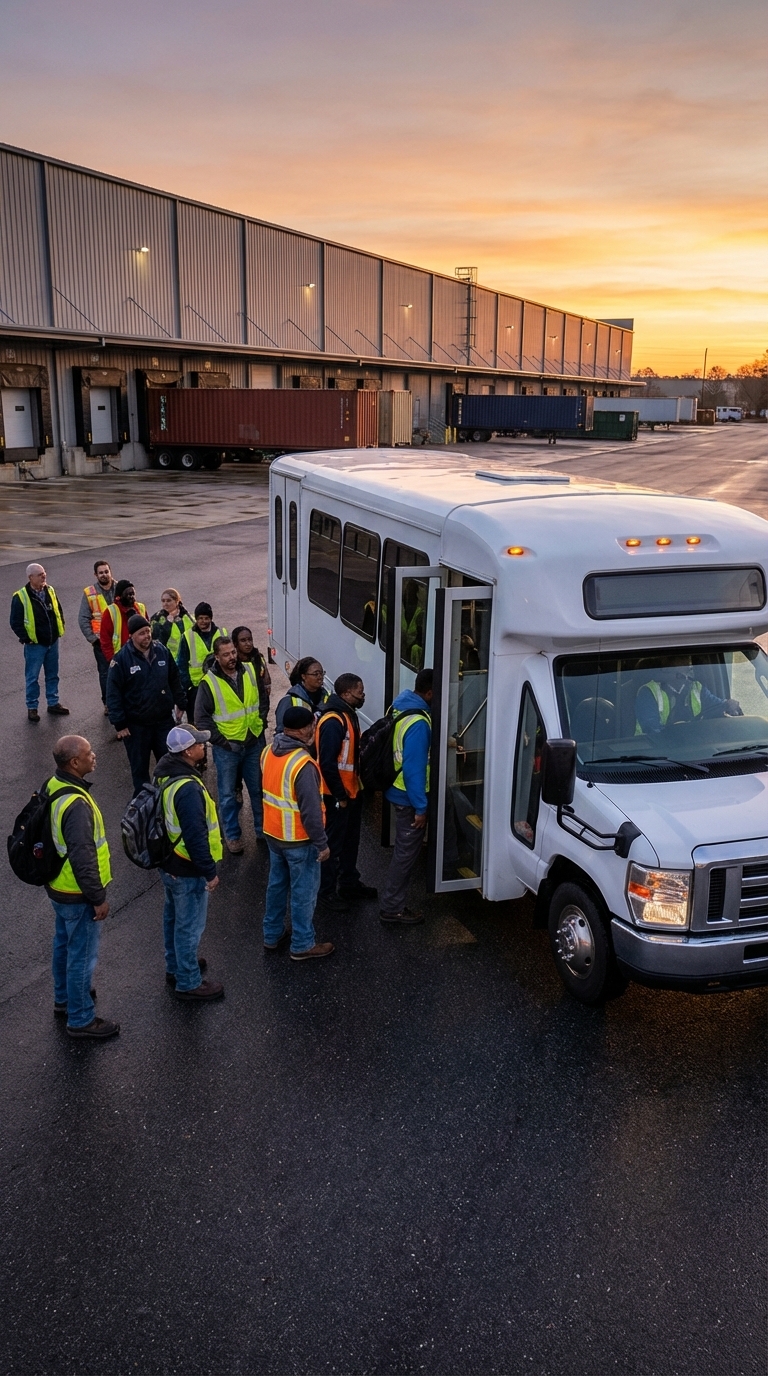
Routes connected workers from two separate labor markets, each more than 60 miles in opposite directions, to a single rural production facility. Vehicle capacity aligned to actual shift schedules.
Ride booking available in multiple languages, with confirmed pickups up to six months in advance in under 30 seconds. A consistent daily commute that makes a rural job accessible to workers in distant markets.
The operations team maintained real-time visibility into active trips across all corridors. Routes refined continuously as ridership data flowed through the platform, without manual coordination.
The program filled 92 positions within four months of launch, representing 46 percent of open headcount. These were roles that had been vacant for an extended period before transportation was introduced.
Filling those positions generated over $1 million in monthly productivity recovery, based on the estimated cost of each open role to the company's operations.
Annualized, the program generated $12.9 million in recovered productivity from a workforce transportation investment that connected two labor markets to a single rural facility.
Get the full case study as a PDF, including program details, outcome data, and how SHARE connects multi-directional labor markets to a single rural facility.
Enter your work email and we'll send you the full case study.
Book a demo to see how SHARE expands your hiring pool by connecting distributed labor markets to your facility.